Comparison
AI Interior Design vs. Traditional Interior Designer: Which One Actually Wins in 2026?
July 20, 2026 · 8 min read · DecorAI Team
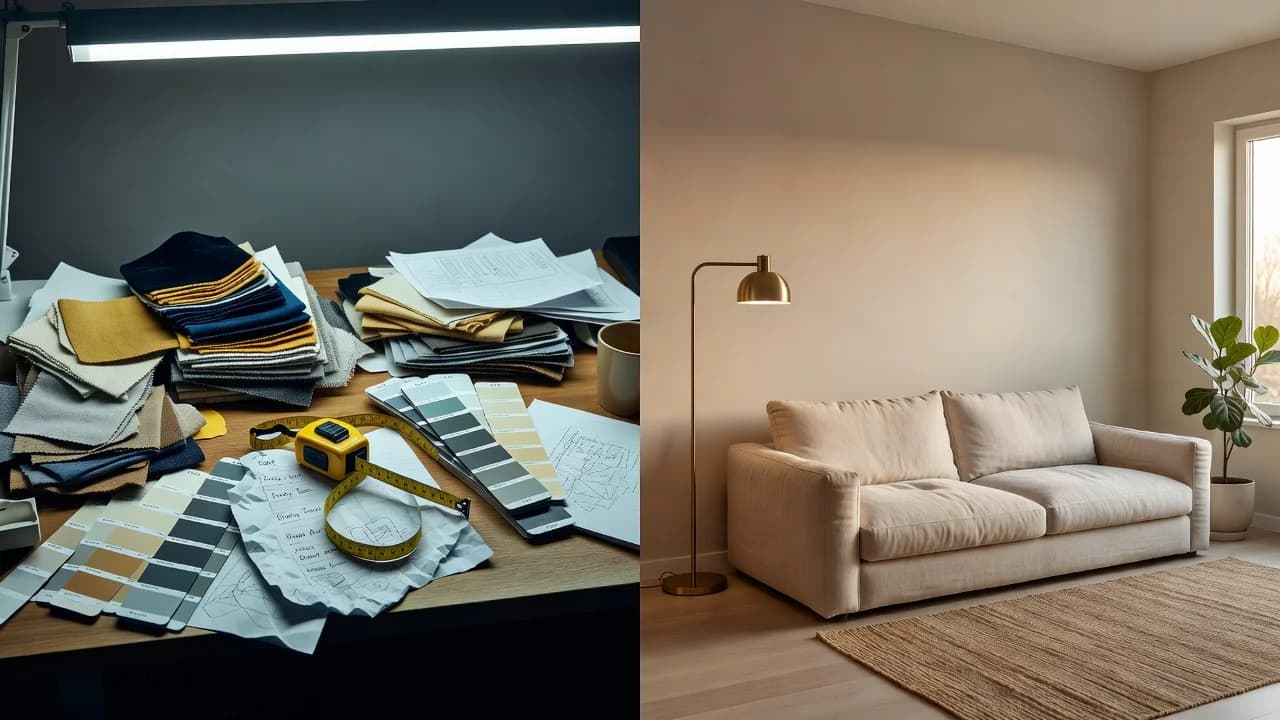
If you want to redesign a room in 2026, you have two real options: hire a traditional interior designer, or open an AI interior design app and let it redesign your actual room from a photo. Both can produce a beautiful result. Only one of them fits most people's budget, timeline, and patience. This guide breaks down the honest differences — cost, speed, realism, and flexibility — so you can decide which approach is right for your home, and why a free AI interior design app like DecorAI has become the practical starting point for most homeowners and renters before they spend a dollar on anything else.
What Does an AI Interior Design App Actually Do?
An AI interior design app uses machine learning models trained on interior photography to redesign a room based on a photo you upload. The best AI room design apps, including DecorAI, keep your room's real layout — the windows, doorways, ceiling height, and architectural quirks — and only restyle the surfaces, furniture, and lighting inside that photo. You pick a style (modern, Japandi, coastal, mid-century, and dozens more), and the AI design generator returns a realistic before-and-after render in seconds, not weeks.
This is different from a general AI image generator, which invents an entirely new room from a text prompt with no relationship to your actual space. An AI interior design app is purpose-built for interiors: it starts from your photo, respects your architecture, and gives you a result you can actually shop for and build.
What Does a Traditional Interior Designer Actually Do?
A traditional interior designer is a trained professional who visits (or video-calls into) your home, takes measurements, discusses your taste and budget, sources furniture and materials, and manages the project — often including contractors, painters, and delivery logistics. According to the American Society of Interior Designers, a full design engagement typically spans several weeks to several months depending on scope, and includes multiple rounds of revisions, sourcing, and installation oversight.
That process has real value for complex renovations — structural changes, full-home projects, or anyone who wants a dedicated professional managing every detail. But for the much more common job of "I want to see what my living room would look like in a different style before I commit to anything," it's a lot of time and expense for a question an AI interior design app can answer in under a minute.
Cost Comparison: AI Interior Design vs. Traditional Interior Designer
Traditional interior designer costs
Professional interior design services are typically billed hourly, as a flat project fee, or as a percentage of total furnishing spend. Fees commonly range from a few thousand dollars for a single-room consultation to tens of thousands for whole-home projects, before you've purchased a single piece of furniture. Renovation-cost research from the National Association of Realtors consistently shows that planning and design fees are one of the largest "invisible" line items homeowners underestimate before a remodel.
AI interior design app cost
DecorAI is a free AI interior design app— you download it, upload a photo, and generate a room makeover at no cost. There's an optional Pro tier for power users who want unlimited generations, but the core experience of seeing your room redesigned in 50+ AI interior styles costs nothing. For most people deciding whether a style even works in their space, that removes the single biggest barrier a traditional interior designer can't: price.
Speed: Minutes vs. Months
This is the starkest difference. A traditional interior designer needs discovery calls, mood boards, revisions, and sourcing lead times — a realistic timeline is weeks at the fastest, months for anything larger. An AI room design app generates a photorealistic redesign of your actual room in the time it takes to make coffee. If you're trying to decide between three styles for a bedroom, you can test all three with DecorAI in the time a traditional designer would still be scheduling your first call.
Realism and Personalization: Does AI Understand Your Room?
The quality gap that used to separate AI tools from human designers was realism — early AI image generators produced rooms that looked impressive but had nothing to do with your actual walls, windows, or proportions. That gap is closing fast for photo-based tools. DecorAI reads your uploaded photo first, preserving your room's real geometry, then applies the AI interior style you select — so the "after" image still has your window in the same place, your doorway where it actually is, and your ceiling height intact. That's the difference between an AI decoration app and a general-purpose image generator, and it's why the results feel personal instead of generic.
When a Traditional Interior Designer Still Makes Sense
To be fair, an AI interior design app is not a replacement for every part of a traditional designer's job. If your project involves structural changes, permits, custom millwork, or full project management with contractors, a human professional is worth the investment. Many DecorAI users actually use the app before that conversation — generating an AI living room design or AI kitchen remodel preview to bring into their first meeting with a contractor or designer, so everyone starts from a shared visual reference instead of a blank page.
Why DecorAI Wins for Most Home Makeovers
For the majority of home makeover decisions — refreshing a living room, testing a new bedroom palette, figuring out if Japandi or coastal styling suits your space — DecorAI wins on every practical measure: it's free, it's instant, and it works from a photo of the room you actually have. You don't need to book a consultation or commit a budget before you even know if you like the direction. That's why so many homeowners now treat an AI interior design app as the first step, whether or not a traditional designer eventually gets involved. See how the process compares to other everyday redecorating habits in Old Way vs. New Way: How an AI Room Design App Is Changing Home Makeovers.
Renters vs. Homeowners: Who Benefits More From AI Interior Design?
Renters have historically been underserved by traditional interior design, and for good reason — most designers are set up for long-term renovation projects, not a one-year lease. An AI interior design app removes that mismatch entirely. If you rent, DecorAI lets you test a cosmetic refresh — new paint direction, different furniture styling, a cozier layout — without committing to structural work you can't make anyway. Homeowners get a different benefit: the ability to test a style across the whole home before spending on a room-by-room renovation, catching mismatches (like a bohemian living room next to a stark modern kitchen) before they become expensive mistakes.
First-time decorators fall somewhere in between. If you've never worked with a designer and don't know your own taste yet, an AI interior design app is a low-stakes way to find out. You can generate the same room in five different AI interior styles and simply notice which one you keep going back to — that's often more revealing than any style quiz.
What a Traditional Interior Designer Can't Replicate
It's worth being direct about where a human designer still has the edge. A good traditional interior designer brings trade relationships, access to custom and made-to-order pieces you can't buy off the shelf, and the judgment to manage a renovation timeline with contractors, electricians, and inspectors. None of that disappears because AI interior design exists. What changes is when you need it. Most homeowners don't need a project manager to decide whether they like a warmer palette in the living room — they need that answered first, cheaply, and then they can decide whether the rest of the project is worth a professional's fee.
Getting the Best Results From an AI Interior Design App
A few habits make a real difference in the quality of your redesign. Upload a photo taken during the day, with the lights on and curtains open, so the AI interior design app has as much detail as possible to work with. Shoot from a normal eye-level angle rather than a tight close-up — wider shots give DecorAI more of the room's architecture to preserve. Finally, generate the same room in two or three different AI interior styles before deciding; the fastest way to find out what you like is to see your own space rendered a few different ways side by side.
Frequently Asked Questions
Is AI interior design as good as a real interior designer?
For visualizing styles and testing ideas on your actual room, an AI interior design app like DecorAI is faster and free. For full project management, sourcing, and structural changes, a traditional interior designer still adds unique value.
How much does DecorAI cost compared to a traditional designer?
DecorAI is free to download and use for AI room redesigns. Traditional interior designers typically charge project fees ranging from a few thousand to tens of thousands of dollars, on top of furnishing costs.
Can I use an AI interior design app before hiring a designer?
Yes. Many homeowners use DecorAI to test styles on their own room first, then bring the results into a conversation with a contractor or designer as a shared starting reference.
Does AI interior design work for renters as well as homeowners?
Yes. Because DecorAI redesigns a photo rather than proposing structural changes, it's well suited to renters who want to see cosmetic refreshes — furniture, color, and styling — without altering the space itself.
Ready to see your own room redesigned? Try DecorAI free on iOS or Android and upload a photo of the room you're thinking about redecorating.